




The Spjass mysteries unveiled – how the move was invented and named
Göran Agdur made a song about it. Champions from Stefan Edwall to Evgeniy Matantsev have used it to secure their world trophies.
But Spjass is not their work – and it has a history of unanswered questions.
Now the truth unfolds.
The name Hans Petersson is too common for quick Google search to be enough. On Facebook or Instagram, he is not to be found in the groups or friend lists where he should appear. Tracking down ”HP” – he was never called anything else in the Swedish tablehockey environment of the eighties – requires some effort.
Suddenly, on a still luke-warm October evening, it pays off when the phone rings.
– Hello, it’s HP. You’ve been doing a bit of detective work, I understand. I like that. Of course I’m not on social media, I’m a teacher after all.
* * *

In Bordshockeybibeln (The tablehockey bible) – an iconic book with feature articles and gameplay instructions that Stiga published in 1988 – we learned that the Spjass move is named after the footballer Albin ”Spjass” Hallbäck. We got to know that he holds the record for most goals in an international fixture for Sweden. We could rattle off in our sleep that they were seven in number and made in 1927 against Latvia.
It would later turn out that ”Spjass” had in fact scored only six goals in the game, but we knew the holy scripture by heart and that was all natural. The Internet wasn’t invented. There was no Youtube where we could study Jacob Lindahl or Lasse Henriksson in detail, no live streams from Stångby or Enköping on a slow Tuesday evening.
We had the Bible and our boyhood dreams. A VHS tape with the former champion Jörgen Sundqvist and the famous tv personality Arne Hegerfors. We learned shovels and centrifuges the hard way. But most of all we practiced Spjass. Boring or not, that was the way forward for us who wanted the throne. After the Lindahl era, all world champions have used Spjass/Nacka, or their mirrored versions, as the primary system for centermoves.
From Stefan Edwall in 1999 to Evgeniy Matantsev in 2023, Spjass – and to some extent Backward Spjass – has driven the evolution of modern tablehockey.
When the founding father of our sport, Göran Agdur, inaugurated the world championships in St Petersburg in 2015, he performed a specially written song whose meaning was already obvious to Borisov, Silis, Caics and the other candidates for the title:
“Ready, aim, fire. Are you ready for my Spjass?”
* * *
The idea for this text was born from three questions.
Is it true, as legendary Thomas Petersson usually claims and as it says on Wikipedia, that the Spjass was originally created by Hans “HP” Petersson in Gothenburg in 1985?
Who named it after an old football player from the club IFK Malmö?
And then the biggest mystery: What, if anything, does the name ”Spjass” actually mean?
Two of the issues are solved immediately when ”HP” calls:
– Yes, it was me. I both invented it and came up with the name, says the 65-year-old.


The Spjass, he says, was born in the footsteps of Hjerpe and Sören, the very first centermoves of tablehockey. Tomas Elfström and Thomas Petersson tormented ”HP” with them.
– I tried them too but I didn’t have the feeling and ended up at a disadvantage. I felt that I needed to come up with something new.
For a passing-oriented player like ”HP”, it could have been more natural with a new three-handed combination or a beautiful diagonal pass. That was the kind of tablehockey he wanted to play. But the Spjass became a necessary evil not to fall behind.
– I placed the puck in a certain spot at the foot and then I swung the puck around and shot with the stick. It was very successful, he says.
In 1984 ”HP” and his team Gothenburg HSS won the Swedish championships for four-man teams. They repeated the achievement in 1985.
– I remember beating Agdur 5-0 when we won the team championships. He put his goalie far to the post but the Spjass went in anyway. It made a difference.
But you who preferred an artistic game style – didn’t it hurt to win with centermoves?
– A little. But I never stopped playing my game. It wasn’t like I just passed the puck to the center forward. Elfström and Thomas were no party poopers either. They could play the beautiful game too, even if they made centermoves.


In May 1987 ”HP” won his first and only national ranking tournament when he was victorious at Gothenburg Open on home soil. But the Spjass was no longer decisive.
– Then I didn’t use it at all, I scored all my goals from open play. You have to be completely relaxed and not think too much when you score a Spjass. I lost the feeling for it at the end.
But seriously now: ”Spjass”, Albin Hallbäck, a footballer from Malmö who had his peak in the 1920s – how did it happen that someone who is also from Gothenburg named his own tablehockey trick after that guy?
– As I am interested in football, I had read that Hallbäck holds the record for the most goals in an international match. Then I thought it sounded groovy. You hear for yourself: ”Spjass”. It was a hit right away. It’s something that moves fast and is cool.
Thomas Petersson was convinced that Albin ”Spjass” Hallbäck must have played for the Gothenburg team Örgryte IS since you have represented the same club at a competitive level in athletics.
– Yes, that was a long time ago. I finished third at the Swedish championships in triple jump in 1980. And then I won the junior title in 1978 and the indoor senior gold in 1979. It’s nice that Thomas remembers. We’ve always liked each other’s game style. He, Agdur and I were the artists. ”Ekis” too. Stig Ankardal was more of a tactician. He won because he could read people. And on his persistence.
***

Albin ”Spjass” Hallbäck was born in 1902 and died 60 years later. He was 25 years old when he joined IFK Malmö from his boyhood side Malmö BI. From an obituary on IFK Malmö’s website, we learn that the transfer took place immediately after the famous game against Latvia. Before that, he had only been on loan during a tour to Germany. The club even points out that a tablehockey move was named for Hallbäck – but when it comes to the etymology of ”Spjass”, article author Lars Ringström has no clue.
”How Albin Hallbäck got his nickname is not answered”, he writes.
If it weren’t for the digitization of Sweden’s daily newspapers, the mystery would likely have remained unsolved. But with a sufficiently specific search phrase in the archives of Kungliga biblioteket, the Swedish national library, the answer appears. It is hidden in a yellowed article from April 6, 1952. In the now dormant newspaper Arbetet, the reporter Lennart – with no surname in his byline – interviewed Albin Hallbäck on his 50th birthday. The headline doesn’t lack servility: ”The record holder of football stands out by far”.
We learn that ”Spjass” ten years earlier was crowned Malmö’s best left winger of all time by an almost unanimous vote, that he ran 100 meters in eleven seconds flat and that he, at the time of the interview, is in a ”really distinguished condition”.
When the six goals against Latvia come up, Albin Hallbäck does not want to take all the credit.
– How did it happen? Well, it wasn’t that remarkable. Not with teammates I had. Imagine Pära Kaufelt in the middle and Sven Rydell to his right. Anyone who couldn’t thrive in that company, he wasn’t worth playing in a national team either. Rydell is my favorite and most things fade by his side, said Albin Hallbäck.
The crucial piece of his nickname puzzle is found in the very first sentence of the article and can easily be missed at first glance. The answer is not delivered in the form of a direct quote, but let’s assume that the reporter got the information from the horse’s mouth in connection with the interview.
“He was generally called Sprallbäck at school, which became Spjass in the vernacular, when the nimble athletic youngster moved on to the football pitch and heard the audience sing his praises”, Lennart writes.
In the direction of international readers, there is now need for a detailed lingual explanation. “Sprallbäck” was a creative mash-up of his surname (Hallbäck) and the Swedish word “sprallig” (meaning “playful” or “frisky”).
It may seem a bit far-fetched that “Sprallbäck” could be verbally distorted into “Spjass”, but there is another logic. The slap-happy, the lively, something that is ”fast and groovy”, to borrow HP’s words. Albin Hallbäck seems to have deserved those epithets.
In other articles from the newspaper archive, it says how he once was awarded as the ”most elegant player” of Allsvenskan, Sweden’s top tier of football. He was also described as ”a really beautiful kind of player who knew the art of shooting directly at passes without stopping the game”.
***
After winning the Gothenburg Open in 1987, Hans ”HP” Petersson’s tablehockey journey was coming to an end. His last major tournament was the Swedish championships in 1993 when he finished 38th. A temporary comeback in the local league in 2006 – when he ended up seventh, just before Patrik Räfling and after Mats Qvist – doesn’t seem to count when he looks back at his career.
– It was fun, but I felt rusty. It took a lot of effort to play defense and then it was just a local tournament in Masthugget (one of Gothenburg’s riverside neighbourhoods).
Do you follow tablehockey these days?
– I check the results sometimes to see if I recognize any names. And then I’ve watched some championship finals on Youtube.
What do you think?
– It’s quite boring. What I have seen has been some Russian who plays really monotonously. Out to the winger, in to the center. It’s dull to watch.
Sure. But then that Russian wins the game with a Spjass. Doesn’t that make you a little proud?
– Well, I guess I must be, especially now that I’m reminded. Of course, the attention surrounding Spjass is funny, but I’m probably more proud to have been involved in the early years together with other enthusiasts like Olle Köhler, Sten Svensson and Stig Ankardal. The fact that tablehockey has now become so big feels incredibly good to me.
Do you play any tablehockey today?
– I do have a game at home, but my old fellows have quit. Occasionally I have played with colleagues at work, but tablehockey is like chess: It is too boring if it is uneven.
Could there be a comeback in the future?
– Maybe. Then it must happen on a suitable level, like some veteran competition. There is a risk that one will be too disappointed, but it would be fun to catch up with people. Is Lars-Erik Svensson still in the game?

Bonus material: Yet another link to tablehockey
After this text was published an e-mail was sent from Berlin. The legendary Swedish tablehockey player Micael Borgh disclosed that he has an at least fairly valid link to Albin Hallbäck. ”My grandfather Carl-Filip and Spjass were teammates in IFK Malmö in the 30s. But the thing is that grandpa was forbidden by his father to play football. Therefore he used the false surname Eriksson for a while.”
Carl-Filip Borgh was warned. His dad considered football an idiotic and dangerous sport and said that his son would break his leg. That turned out to be just right. One day ”Fille, as the son was called, came home with crutches and a fracture. He got, Micael Borgh says, a triumphant reaction from his father. ”Well, mister Eriksson. Didn’t I say so?”
En kommentar till “The Spjass mysteries unveiled – how the move was invented and named”
Lämna ett svar
Du måste vara inloggad för att publicera en kommentar.
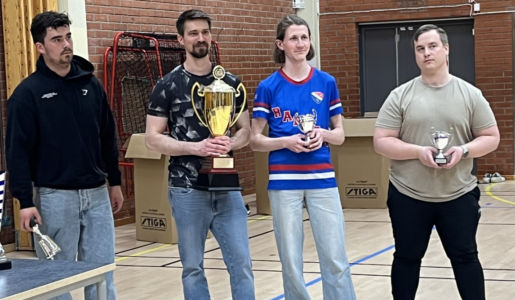
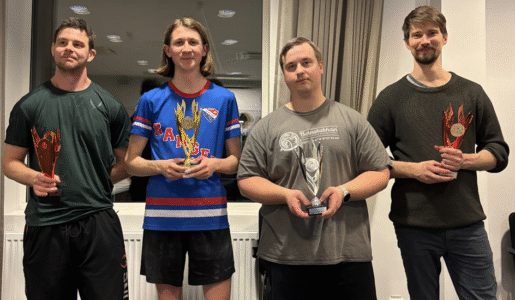


[…] nowhere. Also in this tournament Roni was experimenting a little with his center moves, now making Spjass from an old-style starting position between the stick and the foot. Worked pretty well, that too. […]